Upcoming shows at the Solstice Navan

GalleryPeople2.jpg

EXHIBITION: LUX: Light Art in Ireland

From: 10 Nov 2018
To: 21 Dec 2018
LUX is a group exhibition of sculptural and installation works that use artificial illumination as their primary medium. The participating artists are five of the finest practitioners currently working within this field of artmaking in Ireland.


SOLD OUT – Snow White – SMMS Panto

From: 13 Dec 2018
To: 06 Jan 2019
Following last year’s sell out run of Beauty and the Beast, St. Mary’s Musical Society are back for another action-packed, joke-filled night of fun for young and old! Snow White lives with her Mother in the forest of Fairy Green – a magical place filled with magical creatures, where magical things can happen. When she blindly follows the handsome Prince through the forest, she stumbles upon seven interesting individuals… With the Evil Queen attempting to interfere with fate, how will Snow White ever find her true love, and true love’s first kiss?


SOLD OUT – The Nutcracker – Ballet Ireland

From: 19 Dec 2018
To: 20 Dec 2018
This Irish production of the festive classic, performed by an international cast of world-class dancers, appeals to audiences of all ages with its fairy-tale magic, beautiful costumes and Tchaikovsky’s beloved & sumptuous score. A tale of wondrous adventure that combines to form one of the most delectable Christmas confections imaginable.


SOLD OUT – Eimear Quinn – O Holy Night, A Christmas Concert

From: 21 Dec 2018
To: 21 Dec 2018
In this intimate and spiritual night, Eimear Quinn brings her own special rendition of Christmas songs and carols to Solstice for a memorable musical experience where her ethereal voice will blend beautifully with string quartet and guitar. Allow yourself to sit back and let the hustle and bustle fade away. The Christmas season begins right here, let your spirit be moved!


SOLD OUT – The Lost Brothers

From: 23 Dec 2018
To: 23 Dec 2018
Solstice once again welcomes The Lost Brothers for their famous annual Winter Hootenanny. Since the release of their highly acclaimed 5th album Halfway Towards A Healing in early 2018, The Lost Brothers (Oisin Leech from Navan and Mark McCausland from Omagh) have been on a non-stop world tour, taking in sold-out theatre shows in Ireland and the UK, a stint in America, and their first Australian tour. They now return home with new songs and tales from their travels for this special yearly December concert. Expect songs from all five albums and some festive surprises on the night.


Silver Swans Over 55s Ballet

From: 07 Jan 2019
To: 11 Feb 2019
Silver Swans classes have been specifically designed for the over 55s. Whether you’ve never danced before or want to get back into the swing of it, Silver Swans classes have something for everyone. Classes are taught by RAD and Silver Swans licensed teacher Caroline Kennedy.


EXHIBITION: Surveillé·e·s

From: 12 Jan 2019
To: 01 Mar 2019
Since the beginning of the 20th century, surveillance and spying capacities have accelerated in line with technological advances. Now, at a time when the world is waking up to what is at stake, the Surveillé·e·s investigate both the visible and invisible mechanisms in operation.


Surveillé·e·s – Curator’s Talk with Exhibiting Artists

From: 12 Jan 2019
To: 12 Jan 2019
To mark the opening of the exhibition, join curator Nora Hickey M’Sichili of Centre Culturel Irlandais to discuss the ideas behind the exhibition and talk to some of the exhibiting artists in Surveillé·e·s.


A Star Is Born (2018)

From: 16 Jan 2019
To: 16 Jan 2019
Bradley Cooper plays seasoned musician Jackson Maine who discovers, and falls in love with, struggling artist Ally (Lady Gaga). She has just about given up on her dream to make it big as a singer until Jack coaxes her into the spotlight. But even as Ally’s career takes off, the personal side of their relationship is breaking down, as Jack fights an ongoing battle with his own internal demons.


First Fortnight | Two Days, One Night (2014)

From: 17 Jan 2019
To: 17 Jan 2019
Oscar winner Marion Cotillard gives a rousing performance in this profoundly affecting film. Sandra returns to work after suffering from depression, only to find out that her colleagues have chosen to take a yearly bonus at the expense of her job. She has just one weekend to convince them to change their minds in order to regain her position.


Children’s 6-Week Craft Classes

From: 18 Jan 2019
To: 18 Jan 2019
Our children’s craft classes continue with prop maker, crafter and artist Trisha from Creative Genie! Children will learn a broad range of creative skills, producing artwork from seasonal to general crafts over a 6-week period.


The FitKid Ireland Show

From: 20 Jan 2019
To: 20 Jan 2019
Get an insight into the amazing and unique combination of dance, acrobatics, strength and flexibility in The FitKid Ireland Show, coming to Navan for the very first time, featuring talented children between 3 – 16 years old. Also on display will be routines from children who arrive from the XVI FitKid European Championship from Italy just two weeks before the show. Come and see how fantastic and gifted children live among us!


An Evening With Aonghus McAnally

From: 25 Jan 2019
To: 25 Jan 2019
Following on from his sold out tours celebrating the music of Christie Hennessy in 2016 and 2017, Aonghus McAnally is back with a brand new show. All the songs in the show have personal stories attached to them from humorous to poignant, each delivered in his unique style. An entertaining evening not to be missed.


FREE SCREENING: Spy Kids (2001)

From: 26 Jan 2019
To: 26 Jan 2019
The children of two of the greatest secret agents the world has ever known must take matters into their own hands and work to save their kidnapped parents from danger. This free screening runs in conjunction with our visual arts exhibition Surveillé·e·s which is on display in our Level 3 Gallery until 1 March.


Local weather

REGIONAL FORECAST – LEINSTER

17 December 2018 12:00

Today

Cloudy today with scattered of rain and drizzle spreading from the west this afternoon. Highs of 9 to 12 Celsius in moderate to fresh and gusty southerly winds, which will increase fresh to strong and gusty as the afternoon wears on with near gale force winds developing near the coasts.

Tonight

Cloudy overnight with scattered outbreaks of rain and drizzle at first but more persistent and locally heavy rain will spread from the west overnight leading to spot flooding. Windy overnight also in strong to near gale force and gusty southerly winds, which will reach gale force at times near coasts. Relatively mild with lows of 8 to 11 Celsius.

Tomorrow

Cloudy, wet and windy at first on Tuesday with further heavy rain but the rain will clear eastwards during the morning. The rest of the day will bring a mix of bright spells and scattered showers. The strong to near gale force and gusty southerly winds will veer southwest with the clearance and moderate. It will turn cooler with afternoon highs of just 6 to 9 Celsius

History of county

HISTORY OF MEATH

Meath has come down in the world.   When the name first emerges from the mists of the history, it is of a kingdom, the middle kingdom as its name indicates, possession of which, or power over, which made respectable, though not effective the claim of its ruler to be High King of Ireland.   It became a Liberty  in 1172 when presented by the Angevin King Henry II to Hugh De Lacy and by 1542, divided into two, Westmeath and Eastmeath, the eastern part became known as Meath, the county of today.

Meath in Pre-History

The first traces left by prehistoric man recognizes in the last few years are, the flints of Mesolithic man, man the hunter, left around Randlestown near Navan, 9500 or so years ago.   With the remains of Mount Sandal, Co. Antrim and Lough Boora, Co. Offaly, these are the earliest imprints known today made by man on the soil of Ireland since the great ice caps melted, and the country covered with oak and hazel on low ground, and elm on high ground, became habitable for human beings.

In fact the earliest piece of material shaped by the hand of man found on the soil of Ireland, a piece of roughly chipped flint; was found at Mel, just west of Drogheda, not five miles from the county boundary.   This piece, worked by Paleolithic or old stone age man, is not enough to establish the presence of man in Ireland before the last ice age 2000,000 years ago; it could have been deposited by melting ice which had moved slowly carrying it from what is now Great Britain, or even further east; but it does make feasible a possibility that the great moving ice sheets, did in fact, scour the under-lying land of the presence of old stone age man in Meath and in Ireland.

Again by accident as at Randlestown– there the Mesolithic remains turned up in archaeological investigations of an Iron Age ring fort – traces of later Mesolithic man have turned up in John Bradley’s exploration of a crannóg, or lake dwelling at Moynagh near Nobber.   The paucity of these remains and their scarcity over a period of over 4000 years reveal the first inhabitants of County Meath, hunting for a precarious living, and being threatened in every generation with the likelihood of extinction.

The first farmers who came to Ireland, increasing the food supply and providing a surplus of energy, spent in stone monuments, called in modern times Court Cairns, have survived on the soil of Meath through the post holes of three of their modest oval huts about 5 metres in diameter that have been found in the hill called Slieve Breagh at Rathkenny, just north west of Slane.   It is a barren highland from which eight counties can be seen, and is covered with earth works from both the Bronze and Celtic Iron ages.   It has both atmosphere, eerie and vigorous, presence, and, seen in winter weather, a capacity to reflect something of the pain, strength and stoicism of the so called Court Cairn people who settled there.

The next people who came to County Meath, again like the first farmers, defined by their monuments to the dead, the Passage Grave people, left a more substantial mark on the landscape.   From the Four Knocks on the east of the county not far from the sea through the complex of cemeteries, caught in a crook of the Boyne river five miles from Drogheda to the Slieve na Gallaigh cemetery perched on the highest point of the county, where one cairn about 900 feet above sea level almost comes within the definition of a mountain, spectacular examples of the architecture of these people survive on the landscape.

The best known of course is Newgrange where people, with stone and wood implements not only raised a great mound of 2000,000 tons of gravel containing a passageway of 62 feet long ending in a chamber, decorated with abstract art, sometimes of the highest quality, but also revealed a control over astronomical information – the rising sun about the winter solstice hits a roof box over the entrance to the mound, creeps up the passageway and lights up the corbelled chamber for nearly fifteen minutes – unique in the Neolithic world.  Knowth, in course of excavation, has also yielded new surprising information about these people.   Two passages facing east and west have been found there in one of which an astropomorphic image on a large stone which is a masterpiece art.   Found too, at Knowth was a ceremonial mace head of flint, again with a stylized human image – semi-abstract art of highest quality.   The visible achievement of these people in Meath 5500 years ago reflect a social achievement of which the monuments are the mirror, a structured quasi urban life sustained by a generous supply of food; the beginnings in short of civilization.

The succeeding neolithic peoples with different burial habits – they built a simple grave or dolmen – are not as well represented in Meath as their predecessors, though there is a dolmen at Rathkennynorth of Navan, and a small number of single graves have, in fact, being found.   Some say that the existence of the simple grave as the normal burial pattern reflects a movement away from a closely knit community, bound in familial allegiance that finds expression in a communal grave, to a society divided between an emerging warrior elite that found heroic expression in a single grave culture, and a labouring subject majority whose graves have not survived at all.

At any rate in the years about 2000 B.C. a new people made their presence felt in Meath – the so called Beaker people [ they placed a beaker in their single graves] who came here looking for easily workable sources of pure copper which they eventually mixed with imported  tin to produce bronze.   They found such sources in the quartz outcropping still evident at Kentstown where the Nanny river begins its road to the sea.   They built at Newgrange beside the great mound then 1500 years old, a great wooden hinge or circle at which they put charred animal remains in specially prepared pits.   It has the greatest dimensions of any henge in Western Europe and in it, the post holes of houses have been found.   It was followed by the great stone circle that, with a few gaps, still surrounds the original Neolithic mound.   Some say that the very large circle known as Queen Maeb’s Rath at Tara is also a beaker settlement, made near the Neolithic passage grave there, known as the Mound of Hostages.   Again and again succeeding people were attracted to, and adapted, to their own needs and customs the monuments left by their predecessors.

Meath being blessed with excellent soil attracted every new people to settle on its land.   In the late Bronze Age the Mound of the Hostages itself a Neolithic grave, was used for Bronze Age burial; one grave, of a teenager of some importance, yielded a necklace of amber and faience, the former an import from the eastern Baltic sea, the latter a milky blue bead made in Egypt, both showing the far flung trade contacts of Meath in the Bronze Age.

In the centuries before the birth of Christ a new technology, art style and point of view from which to measure human values shaped the culture of people living in Meath.   The celtic centuries had begun.   The secret of making furnaces hot enough to smelt iron made for an advanced iron technology, the adaption of the La Tene motifs or decoration, on bronze and stone at first in the northern half of the country reveals a people with a flair for seeing mysterious quasi divine forces behind natural phenomena, and the familiar character of the basic political unit, the vath, of which there were about eight in what is now Co. Meath, implies an incapacity for empire characteristic of the whole Celtic world.   The physical expression of this on the landscape is of course the absence of any large scale buildings for political or religious purposes.

The dwelling units of the Irish Celts dot the landscape, mostly circular rings of earth thrown up from, and creating a surrounding ditch inside, which were the ephemeral huts for humans and animals.   Below the surface of the ground at these, so called ring forts, found very frequently in Co.Meath are the L shaped tunnels called sousterrains which seem to have been places of refuge from frost and enemy alike, and perhaps cool storage places for food and perishable goods.   In Meath too, are some spectacular Celtic sites, spectacular not because of buildings, but because of view and position.   There is the Hill of Ward near Athboy, a tri-vallate ringfort much disturbed since; the sites about Teltown  which relate to those sacred games held every three years, at which was reaffirmed the marriage of him who claimed to be High King to his people; and of course Tara itself, a complex of ringforts on a grand scale, centred on the Neolithic passage grave called the Mound of Hostages, entered by an imposing sacred way and dominating the surrounding central plain of the county.

The primary political unit in Celtic Ireland was the tuath, of which there were about eight in Meath, ruled by a chief, or petty king chosen from the extended family of his predecessor.   The names of these petty kingdoms have often survived as the names of baronies in early modern Meath; Lune and Morgallion reveal the presence of the Luaigne [followers of the Celtic God Lugh], and the Gailenga.   The chiefs paid or received tribute from one another and all paid tribute to a ri coicead, the provincial King of Meath whose sway stretched from the Shannon to the sea.   Below the chief were, the representatives of his family, and the independent farmers whose ringforts still cover the county.   With him the learned classes, interpreters of the law, doctors, the poets and genealogists and the free tradesmen made up the free inhabitants of the tuath; below them the unfree, servants, labourers and musicians, worked to keep the rest in relative comfort.

In the early Celtic age, about the time of Christ, the provincial centre was at Tara which had such a hold on the imagination of the people of the area, that even when it was long abandoned as a centre of power, the king of Tara was the coveted of the provincial king of Meath.

Win a House for €100

Meath GAA – in partnership with Glenveagh Homes – are giving you the chance to win one of three beautiful 3-bedroom houses – and valuable runners-up cash prizes in three separate draws being run between now and October 2019!

The Meath GAA Royal House Draw is a fundraiser aiming to raise between €1.5m and €1.8m for the redevelopment of Páirc Tailteann in Navan. The first of the three draws will take place on October 31st 2018. On offer is a a three-bed, semi-detached house at Cois Glaisin in south Navan, valued at €275,000. In addition to the house, there is a range of cash prizes on offer ranging from €1,000 up to €10,000.

Tickets for the draw are €100 each with a special discount rate of €250 for anyone interested in purchasing tickets for each of the three draws (1 per draw). This special discount rate is only available in advance of the first draw.

Purchase your draw ticket online today via MyClubFinances.com or to find out more visit royalhousedraw.com

The maximum number of tickets to be sold for each draw is 12,000. Good luck to all participants and thank you for supporting this fundraiser for the redevelopment of Páirc Tailteann.

Rivals unite as Sean Cox fundraiser sees Meath overcome All-Ireland champions Dublin

Meath 0-16

Dublin 1-11

MEATH RECORDED A two point victory over All-Ireland champions Dublin on Sunday afternoon at Páirc Tailteann, as the two rival counties united together to raise much-needed funds for Sean Cox.

The father-of-three was brutally attacked unprovoked prior to Liverpool’s Champions League semi-final meeting with AS Roma in April, with all funds from Sunday’s match going towards his aid and medical expenses.

Andy McEntee’s men went into the half-time interval three points to the good. A second-half goal from promising young Dublin forward Stephen Smith saw Jim Gavin’s side reduce the deficit, however the Royals would hold on to secure a 0-16 to 1-11 win.

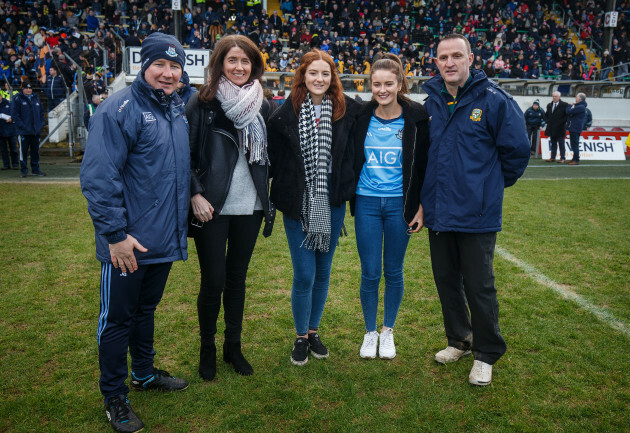
Martina, Emma and Shauna Cox with Jim Gavin and Andy McEnteeMartina Cox, wife of Sean Cox, with their daughters Emma and Shauna alongside Jim Gavin and Andy McEntee.Source: Oisin Keniry/INPHO

Both teams hold up a sign in support of Sean Cox before the game.Source: Oisin Keniry/INPHO

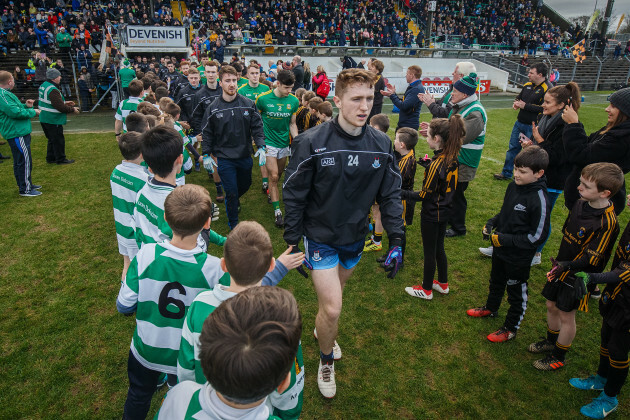
Paddy Small makes his way through the guard of honourDublin’s Paddy Small makes his way through the guard of honour.Source: Oisin Keniry/INPHO

Thousands attended the fundraiser for the St Peter’s Dunboyne GAA clubman, with all proceeds helping Mr Cox in his recovery.

The 53-year-old was left in a coma following April’s attack, suffering serious brain injuries as a result of the assault outside Anfield eight months ago, with his recovery ongoing at the National Rehabilitation Hospital in Dun Laoghaire.

A number of fundraisers and donations have helped towards his medical expenses, with Ireland captain Seamus Coleman, Jurgen Klopp, Liverpool Football Club, AS Roma and its club president Jim Pallotta all making sizeable contributions in recent months.

Supporters can still make a donation towards Cox’s ongoing medical costs through a GoFundMe page, which has raised more than €537,000.

Sean McMahon with Michael NewmanDublin’s Sean McMahon with Michael Newman of Meath.Source: Oisin Keniry/INPHO

Tourism information

Boyne Valley – a rich and royal land

County Meath is known as the Royal County as it was once the territory of the High Kings of Ireland. The abundance of historic monuments within the present day boundaries testifies to the ancient importance of the region. Some of the most important historic sites and monuments are located within County Meath and virtually every important aspect of Irish history from prehistoric times is associated with the county.

Tara - Aerial View

The rich landscape of pasture land watered by the scenic rivers of the Boyne, Blackwater and their tributaries results in Meath being a prosperous agricultural county with some of the best land in Ireland. It is particularly noted for its fine horses and cattle.

The two main rivers in the county, the Boyne and the Blackwater join at Navan, which stretches to the Irish Sea, is the most historic waterway in Ireland. The rich legend of the Boyne with Fionn MacCumhall and the Salmon of Knowledge is still told today. The waterways are rich in aquatic life and the salmon and trout are recognised as among the finest in Ireland.

On the upper stretches of the Boyne, at Trim, is the greatest of the Anglo-Norman castles in the country, while near the Blackwater at Kells, are the ruins of the 9th century monastery founded by the monks from Iona in Scotland. About that time, the illuminated master manuscript, the Book of Kells was completed.


Kells Round Tower and Kells High Cross

Kells Crosses

The Boyne Valley is probably one of the most interesting areas in Ireland to visit. The massive megalithic tombs and passage graves at Newgrange, Dowth, Knowth and Loughcrew, the Royal site at the Hill of Tara, Tailteann, the site of the Great Aonach which continued tri-annually for over 3,000 years, monastic houses at Trim and Bective, 16th and 17th great houses, are all vivid reminders of a glorious past.

Ancient heritage site of Newgrange (3200Bc) with family

Newgrange, County Meath

For the Irish scholar or people wishing to learn the Irish language , facilities are available at the flourishing Gaeltacht at Rath Cairn where many natives and visitors holiday and study, often returning year after year. Traditional music and dance, Comhaltas Ceoltóirí Eireann, is available throughout the County with one of the most popular locations being Oldcastle.

Loughcrew Cairns covered in snow

Loughcrew Cairns in Winter

As a sporting location, the county has a great deal to offer. National Hunt and Flat racing is regularly held at Fairyhouse ( home of the Irish Grand National) and Bellewstown ( for over 300yrs). Laytown is a unique event where the horses race on the beach. Proudstown Park in Navan is one of the finest possible tests for National Hunt horses, with an uphill finish similar to Cheltenham. There are many facilities for equestrian sport throughout the county and stag and fox-hunting is possible with several of the hunt clubs.

From the historical Tara Hill and Newgrange, to the fun packed coast to the tranquil gardens and Boyne walks Meath offers something to satisfy all interests.

Trim legend dies suddenly

It is with sadness that we have learned of the death of 2nd Year Psychology student Zak McGowan. Our thoughts are with Zak’s family and friends at this tough time. R.I.P – Ar dheis Dé go raibh a anam.

Students who wish to remember Zak can visit the Student Services Centre over the coming days to sign the Book of Condolence.

We are available to help any students who may be affected by this news with the following support services available to all students:

MSU Welfare and Equality – Kim Lockyer – welfare@msu.ie

Counselling Service: Call 708 3554 or avail of the Drop-in (no appointment necessary) service at 2pm each day www.maynoothuniversity.ie/counselling

Chaplaincy: Mr. Ciaran Coughlan – available in Room 49, Arts Building. Contact 708 3320 www.maynoothuniversity.ie/chaplaincy

Student Support Officer: Ms. Marianne Dunne, Ground Floor, Student Services Centre. No appointment necessary. Drop in or contact 474 7627.

Health Centre: Open 9am–12.45pm, and 2–4.45pm daily. Drop-in clinic (no appointment necessary) at 9.30am and 2.30pm each day. Contact 708 3878https://www.maynoothuniversity.ie/stu…/student-health-centre

Image may contain: fire, candles and night

Trim castle

Trim Castle (or King John’s Castle) is Ireland’s largest Norman castle. It was built in the late 12th century following the Norman invasion of Ireland. Trim and the surrounding lands were granted to Hugh de Lacy, Lord of Meath, a Norman baron. Richard II of England stayed there before being ousted from power. Once a candidate to be the country’s capital, the town has also occupied a role as one of the outposts of the Pale, and sessions of the Irish Parliament were sometimes held here, as in 1542. ITrim_Castle_6 (1)t was also designated by Elizabeth I of England as the planned location for a Protestant Dublin University (known as Trinity College, Dublin).[6] However this was revised by Sir Francis Drake, who advocated the case for locating the University in Dublin. In 1649 after the sacking of Drogheda, the garrison of Trim fled to join other Irish forces and the town was occupied by the army of Oliver Cromwell. There were many local disturbances in neighbouring villages in the Irish Rebellion of 1798, most infamously the battle on the Hill of Tara, following the dispersal of the Wexford rebellion. Trim was represented by Arthur Wellesley in the Irish Parliament from 1790 to 1797.

Places to visit in Trim

Places of interest

220px-St_Patrick's_church,_Trim

St Patrick’s church, Trim
Viewed from the castle’s southern curtain wall.

Trim courthouse

Sheep’s gate in the morning

  • St Patrick’s church (Roman Catholic), Church Street
  • St. Patrick’s cathedral church (Church of Ireland), Loman Street. It is reputed to be the oldest Anglican Church in Ireland (disputed by a church in Armagh which claims its 20 years older than the Trim Church). The original church lies in ruins behind the current newer church which faces onto Loman Street from behind a large boundary wall.
  • Trim Castle, the largest Cambro-Norman castle in Ireland which was built by Hugh de Lacy, Lord of Meath. It was used in the production of the film Braveheart.
  • The Town Hall, known locally as the Market House, is reputed to have been one of Thin Lizzy’s first concert venues, and has seen U2 and several other noted bands play there over the years.
  • The yellow steeple (named so for the way the sun sets and rises on it in the giving it a yellow colour), the remains of a 14th-century St. Mary’s Abbey on a hillside near the town centre, is the tallest building in Trim and can be seen for kilometres around the town.
  • Trim Town Walls – Though not much remains of the original walls of Trim, the “Sheep Gate” stands near the ‘yellow steeple’ and the castle. The wall in this area is in ruins but it marks the original town boundary, the only intact part of the wall stands on Loman Street It is not marked by any signs but it starts around the front of St. Patrick’s Anglican church and runs down to the local ‘Costa Coffee’ (prev. The Priory Inn.)
  • The Black Friary – A 13th century Dominican Friary located just outside the town walls. The excavation of the remains of the friary is part of the Blackfriary Community archaeology project.
  • The Boyne river walk is a walkway along the river Boyne starting at the castle park and running along the Boyne to Newtown abbey. The total walk to Newtown and back takes about 40mins.
  • Newtown Abbey lies on the banks of the Boyne about 15min walk from Trim Castle. It once was the largest Abbey of its kind in Ireland. It is still used as a graveyard for the town so there are no guided tours but there are lots of Information boards with pictures of what certain areas used to look like.
  • St. John’s Priory, a medieval hospital, lies across the Boyne from Newtown abbey. This structure is again free access. At the entrance there is a defence tower which used to form part of the walls of the hospital.
  • Trim Circuit Courthouse – Built in the 19th century, the courthouse overlooks the main street of the town. Recently extended with an award-winning design, the courthouse is located next to the main entrance of the castle.

Events

Trim Vintage and Veteran Car Show

An annual classic car show takes place in Trim every July, Trim Veteran and Vintage Rally has been running since 1985. It started in a small yard on Loman Street with just 1 car. The founder, Norman Pratt, along with his hand-picked committee, were determined to expand the show, approached the Roundtree family who very kindly allowed the Porch Fields to be used on the day. The committee included secretary Ms Iris Wilson, PRO Frank Dempsey, Billy Wilson and George Douglas. It has grown each year since then and there are now in excess of 500 cars and motor cycles on show. Visitors to the show can also try their hand at archery with Athboy Archery Club. The archery has always been a big success at the fair.

Trim Haymaking Festival

Trim Haymaking Festival is held in the town every mid-June. The Porchfields, an amenity space rich in historic value, are home to a fair, market, and cultural displays. The main event is the traditional making of the first hay of the year by hand and by old-style machinery.Visitors to the show can also try their hand at archery with Athboy Archery Club. The archery has always been a big success at the fair.

Trim Swift Festival

Because of Jonathan Swift‘s residence near Trim after 1700, a satirical festival is held in his honour.[10]

Royal Meath Show

The Royal Meath Show takes place annually in porch field on the first Sunday in September each year. The main evert of this agricultural show are judging of cattle, sheep, goats, horses, dogs and home industries and there are also trade stands and vintage machinery and many other attractions.

haymaking